The Ultimate Startup CSM Playbook

Chinmay Pingale
Co-founder & CEO

Chinmay Pingale
Co-founder & CEO
In this guide, we'll explore how Customer Success has evolved from a support function primarily oriented to enterprise companies to a well recognized growth framework for high-growth startups. We'll dive into operationalization of these principles and how they can be applied to build a scalable, revenue-driving CSM motion.
From an emotional standpoint, winning new deals is the best feeling in the world, but from a revenue standpoint, recurring deals go much farther. A study from Harvard Business Review says customer retention rates by 5% can increase profits by 25% to 95% through the economics of loyalty and retention.
Anecdotally, I've heard that companies like Ontic invest more into their retention than new sales. Keeping a customer is more important to them than getting a new one, if they had to pick one. Knowing if this is right for you comes down to a simple thought exercise. Ask yourself, "is it more work to prospect, sell, legal, and onboard a customer or provide value to an existing customer and have a renewal discussion (little legal, no prospecting, no onboarding).
What I made my unique advantage, and you can too, is investing more than your competitors into retention, especially because the ROI on that is much higher.
Nonetheless, hopefully by this point you know retention and customer success (CS) is important.

If you are a business to business company, the best time will likely be much, much sooner than you think. Playbooks do not mean hiring more CSMs, it means encoding a repeatable plan to a certain trigger.
Well, why is it important if you have no CSMs? Firstly, it's to offload the cognitive load on your brain to have to remember the steps. What probably happens today is you jump right into a problem and 'do what feels right'. This is the equivalent in code of rewriting code (you should not do that) when you really should just be creating a repeatable function you can call that does the steps you want it to. The CS equivalent of that is playbooks.
As soon as you start to notice repeated patterns in risk response or onboarding, you should be making a playbook. These are the moments that define if a customer will stick around or not, and having your best set of plays written down will be a huge time, effort, and revenue saver down the line.
If I was reading this as a founder, the first thought to myself would probably be, "*In a risk response or onboarding moment, I'm probably not going to go to a document". *To that, I have a solution.
The first thing you must know is that I'm referring to a playbook as the 'bible' of any tumultuous customer facing moments that have a retention impact.
So, what typically are these?
Onboarding is the most universal. Good and bad onboarding can, and very often is, the difference between renewing or cancelling a contract or poc. One of the highest leverage onboarding investments I've seen is a small library of product walkthrough videos so customers aren't waiting on a live call for every question.
The other is risk response. Every company will have different risks they may see. Examples include, but are not limited to:
Hundreds more. Every company has their own they'll start to notice repeatedly surface up.
So, where should these documents live? The very best place is somewhere you know you'll find yourself going when the moment happens. For the step by step, I'll explain how you can do it with something more static, like a google document, and something more proactive, like Cuelock.
At this point, you already noticed a repeated risk that your company faces post-sale. For example, let's say you work in a field where reorganization is a common risk type you face.
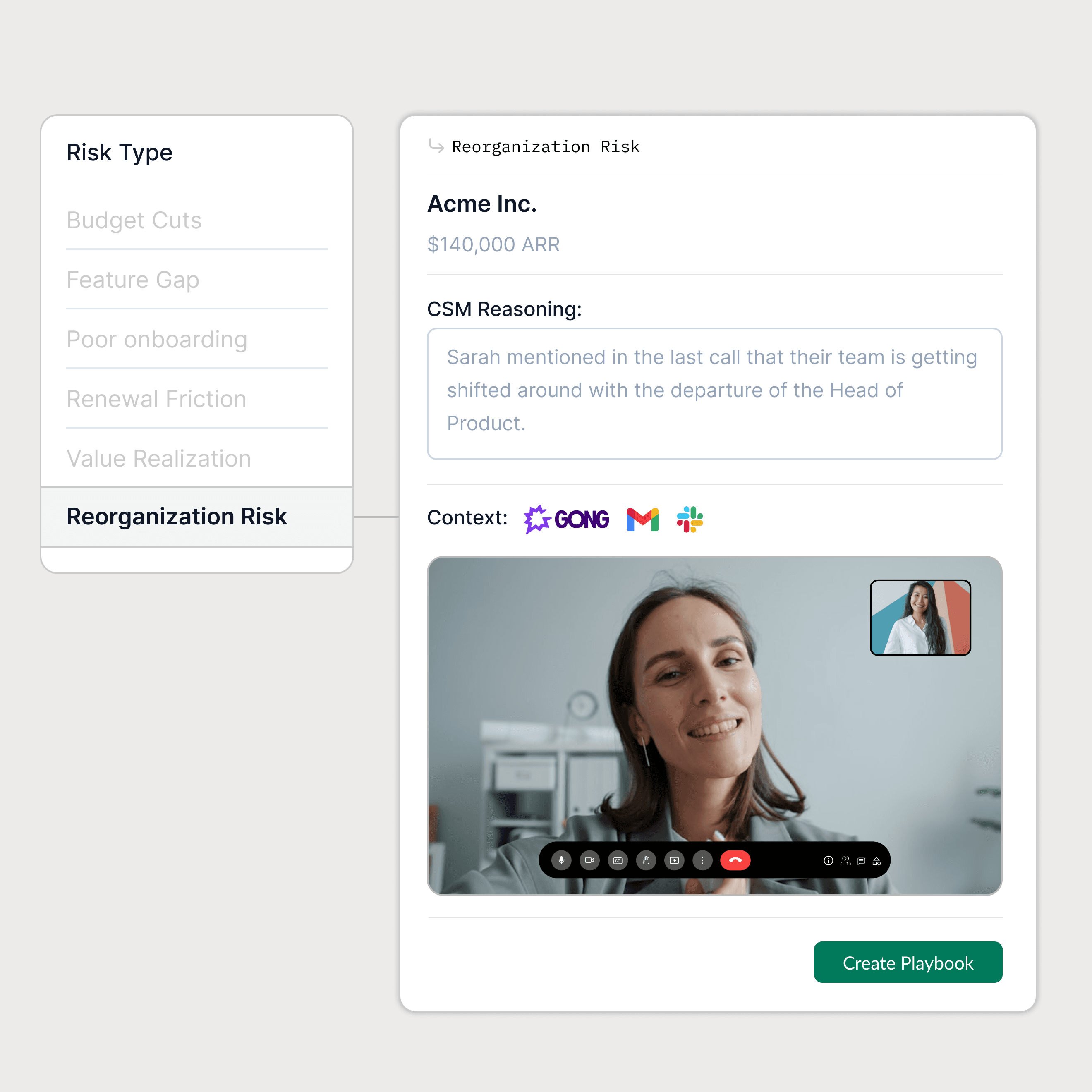
Now that your playbook templates have been scribed somewhere, we'll take a look at using them in practice.
So the playbook has been written, and now we're in the action. You're going about your day, and then BOOM, one of your customers just informed you, or a CSM, that they are no longer going to be the contact because they are leaving the firm. What happens?
Preparation
Execution
Preparation
Execution
Here, both ways are effective, but the primary difference is in the manual document way, the cognitive load of remembering, interpreting, and executing is entirely on you or the CSM. Cuelock will allow you to only have to put in information once, at the beginning, and will become the engine for resolution.
It's crucial that you actually know what works and what doesn't. It's easy to depend on anecdotal evidence on what works, but that can cost an arm and a leg down the line if systems are built upon wrong, or even slightly wrong, beliefs about what is going on.
As a founder that is trying to build a sustainable, scalable company, it's crucial you get this right. You need to know what worked, at what point, and at what step of any playbook.
Playbooks are meant to be iterated, especially at the start.
For document playbooks, you have to create a copy of a case-specific playbook you ran, and you need to log when it was run, what tasks were taken, which company it involved, and more. You can do this by creating a google sheet and having the following columns:
For Cuelock:
In both scenarios, what you get is a very valuable log at the end of a term showing exactly which risks occurred the most, how you responded to them, what worked, what didn't, and more.
You can see the intricacies of which type of customers had which risks, how they are best handled, and share that with any CSM that joins in the future. In other words, you've made a scalable system.
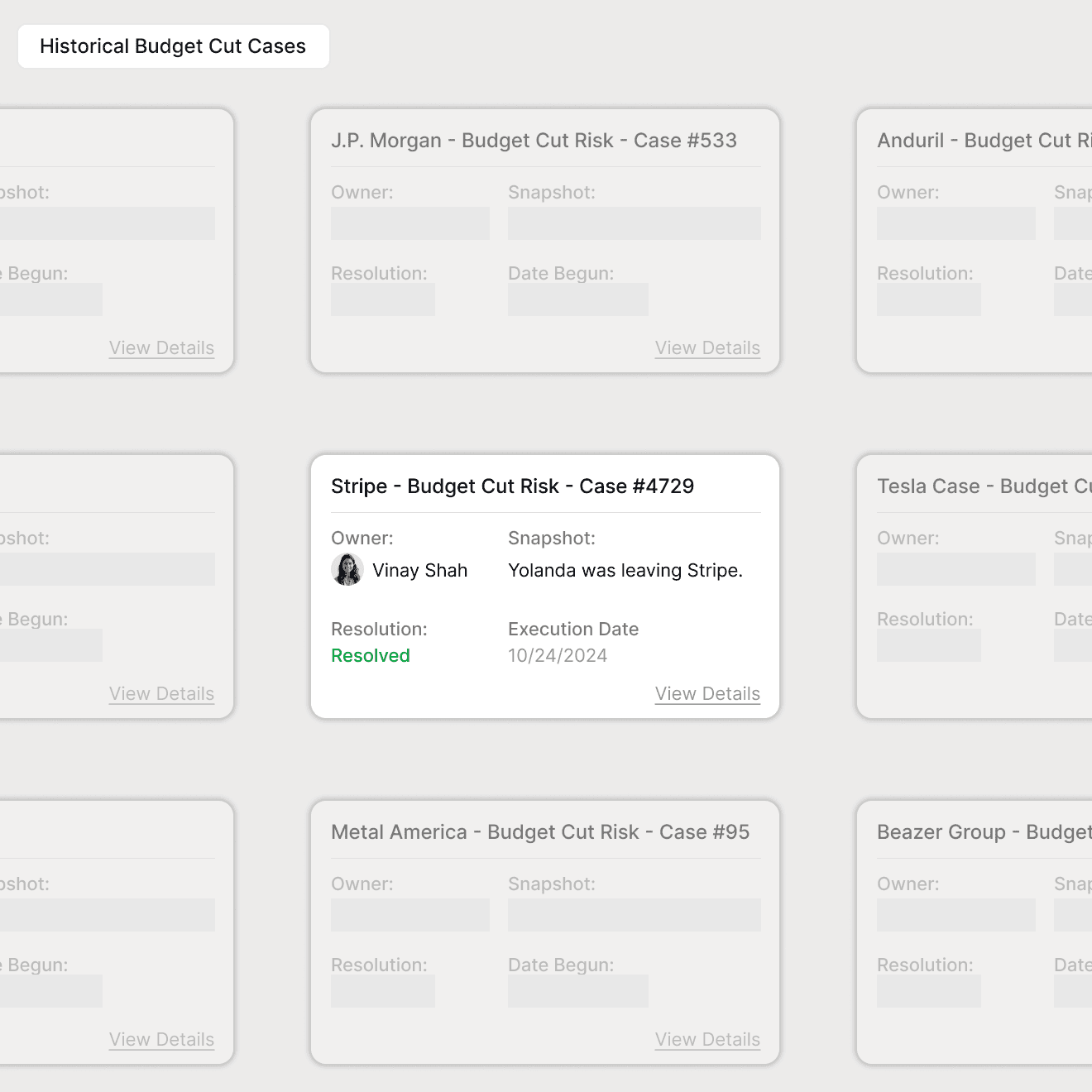
The key is, that has to continue as you bring on CSMs. Cuelock ensures it will, but a document / sheet may have a rough time.
At the startup level it's difficult to gauge this effectively, but the most important two metrics is:
Everything else is vanity. In business, people will vote with their dollars. It's tough to gauge a before playbook and after playbook at the startup level, but as a founder, you will quickly see the value of a repeatable, adaptable set of playbooks, and can make a safe assumption on if these playbooks had a causal relationship to better GRR and NRR.
Running a business is extremely difficult. Starting a company is ultimately just a series of picking which battles you want to fight. To me, playing the customer success + product game paid off, and hopefully for you, it can too!
Feel free to reach out if you have any questions and if creating and operating playbooks is something you want to get serious about, check out Cuelock!
Written by
Chinmay Pingale · Co-founder & CEO
Chinmay is the co-founder and CEO of Cuelock. He writes about customer success operations, retention, and the mechanics of expansion revenue.

AI agents built around your customer success team, your customers, and your playbook.
 ChatGPT
 Claude