The Best Customer Churn Dashboards and Software for 2026

Chinmay Pingale
Co-founder & CEO

Chinmay Pingale
Co-founder & CEO
I'll be blunt. Most churn software tells you who's about to leave. Very few help your team actually do something about it.
That distinction matters more than any feature checklist. You can have the sharpest health scores in the industry, a dashboard that would make a data team weep with joy, and AI that predicts churn with 94% accuracy. None of it matters if your CSM stares at the alert, opens Slack, types a vague message to someone who may or may not be the right person, and then moves on to the next fire.
The gap between "knowing" and "doing" is where most retention revenue dies. So that's the lens we used for this list.
We evaluated seven tools across a spectrum: enterprise CS platforms, real-time engagement engines, structured risk-response systems, payment recovery specialists, and lightweight starters. Each entry covers what the tool does well, where it falls short, directional pricing, and who it's best suited for.
One column worth paying attention to: Resolution Tracking. That's the ability to capture not just that an account was at risk, but how the risk was handled and what outcome it produced. Most dashboards don't track this at all. It's the difference between knowing your churn rate and knowing why it is what it is.
| Tool | Best For | Health Scores | Playbooks | Resolution Tracking | AI Features | Free Tier |
|---|---|---|---|---|---|---|
| Cuelock | At-risk response | Yes | Core strength | Core strength | Yes | Yes |
| Gainsight | Enterprise CS | Yes | Yes | Limited | Yes | No |
| ChurnZero | Churn scoring | Yes | Yes (Plays) | Limited | Yes (Agents) | No |
| Vitally | Growth-stage SaaS | Yes | Yes | Limited | Yes (Copilot) | Trial |
| Totango | Modular workflows | Yes | Yes (BLOCs) | Limited | Yes | Yes |
| Churn Buster | Payment recovery | No | No | Payments only | No | No |
| Custify | Small teams | Yes | Basic | No | No | Trial |
Here's what probably happens at your company today. An account shows signs of risk: usage drops, a key champion goes quiet, a support ticket escalates. Your CSM gets an alert. Maybe from your CS platform, maybe from a Slack bot, maybe from gut instinct.
Then what?
They improvise. They ping someone in Slack who might know the account. They draft an email that may or may not hit the right tone. They log a note somewhere, maybe. Three weeks later, a VP asks "what happened with that account?" and nobody has a clean answer.
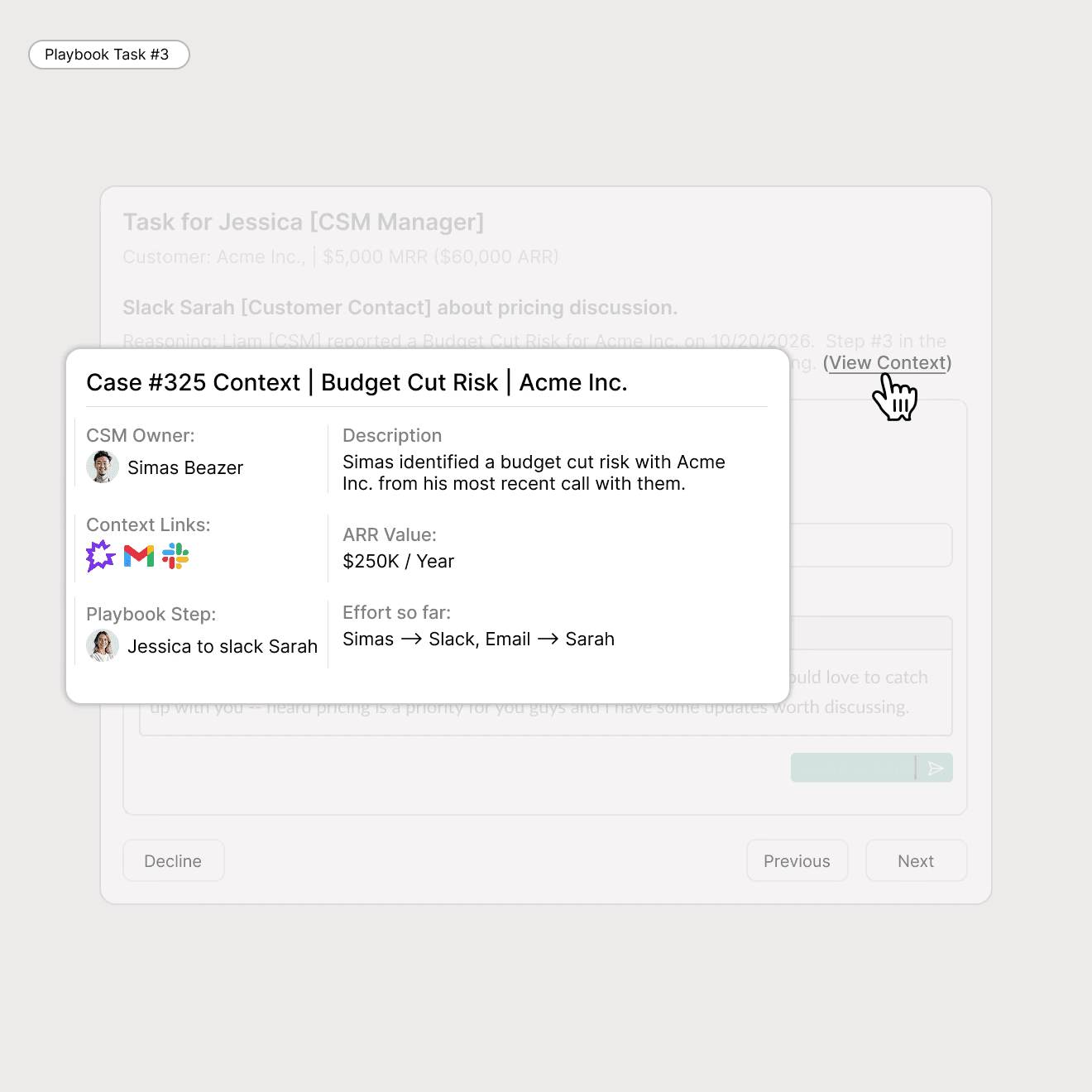
Cuelock exists to kill that cycle. When an account triggers a risk signal, the CSM doesn't get an alert and a prayer. They get a situation-specific playbook that tells them exactly what to do: which stakeholders to pull in, what outreach to prepare, what sequence of actions has worked for this type of risk before.
What stands out
If I were reading this as a skeptical CS leader, I'd probably think: "We already have playbooks in our CS platform." Well, ask yourself: when an account went red last quarter, did your team execute a consistent, documented response, or did they wing it? If the answer is "it depends on the CSM," that's the gap Cuelock closes.
Pricing
Contact Cuelock directly. The platform is built for mid-market and enterprise CS teams managing meaningful portfolios.
Best for
CS teams past the "just monitor churn" phase who need a repeatable system for responding to risk. Especially strong where multiple people touch at-risk accounts and leadership wants visibility into how those situations are handled.
Honest limitation
Cuelock is purpose-built for the risk-response layer. It doesn't replace your health scoring or product analytics platform. You'll likely pair it with another tool on this list, and that's by design. It's the execution engine, not the dashboard.
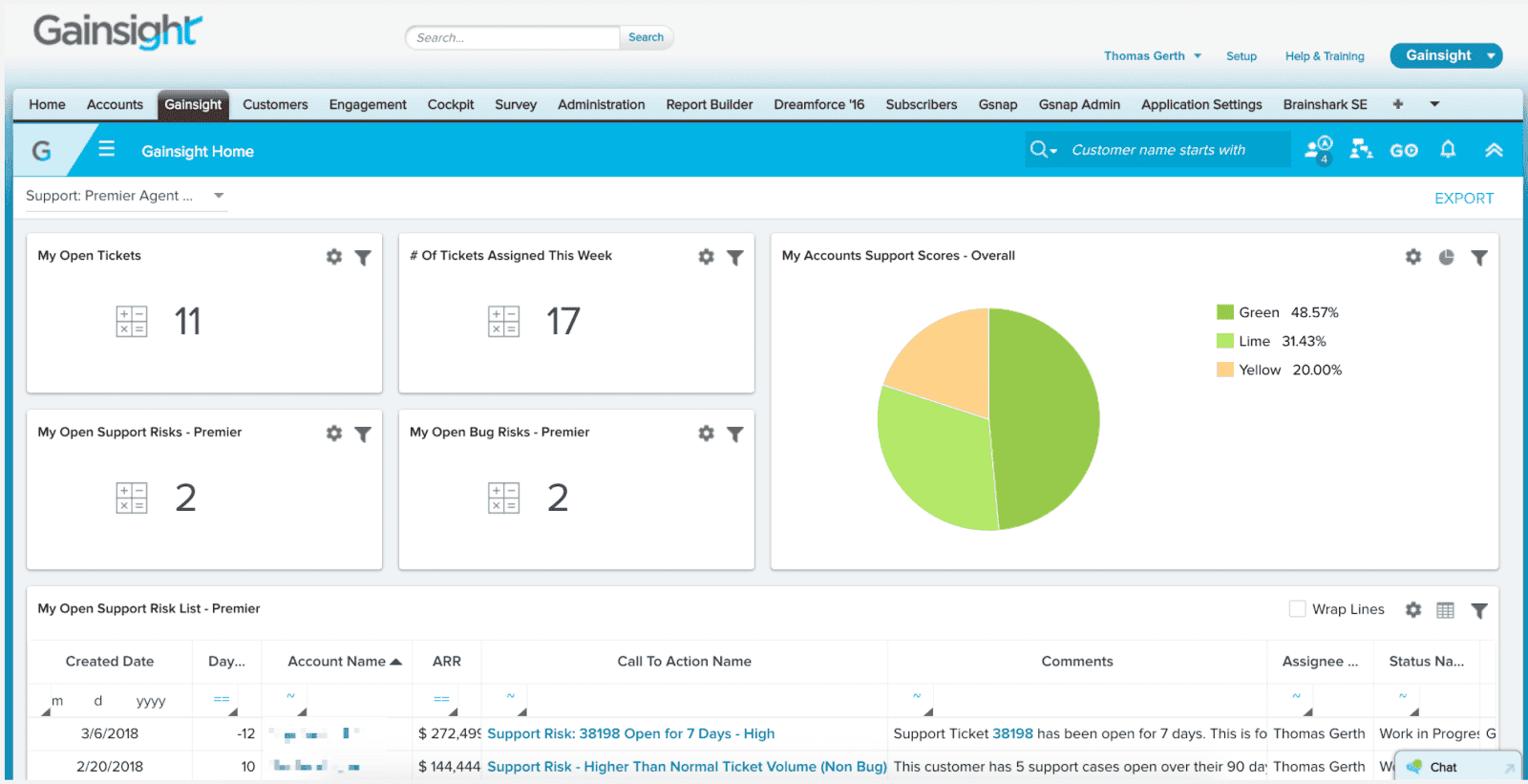
Gainsight is the tool everyone benchmarks against, and there's a reason for that. It has the deepest feature set in the category: health scoring, journey orchestration, product analytics (via Gainsight PX), customer education (Skilljar), community management, and AI-powered sentiment analysis through Staircase AI. If your CS org runs a complex, multi-touch post-sales motion across hundreds of accounts, Gainsight can handle it.
The trade-off is real, though. Gainsight implementations are measured in months. You will need a dedicated admin or ops resource to keep the system calibrated. And the UI, while powerful, shows its age compared to newer entrants like Vitally.
I've heard from multiple CS leaders that Gainsight delivers tremendous value once it's dialed in. The problem is getting it dialed in. If you have the team and the budget, it's the category leader for a reason. If you don't, you'll be paying enterprise prices for a fraction of the platform's capability.
Key capabilities
Pricing
Custom, quote-based. Third-party estimates put it starting around $2,500/month, with enterprise contracts commonly running $23,000 to $60,000+ annually depending on seats and data volume. Implementation can add $10,000 to $50,000 on top.
Best for
Large CS organizations (10+ CSMs) with dedicated ops resources, complex customer segments, and the budget to invest in a platform they'll grow into over years.
Honest limitation
Long implementation, steep learning curve, and pricing that's out of reach for most sub-50-person companies. Some reviewers on G2 and Capterra describe the system as "clunky" once you get past the core workflows.
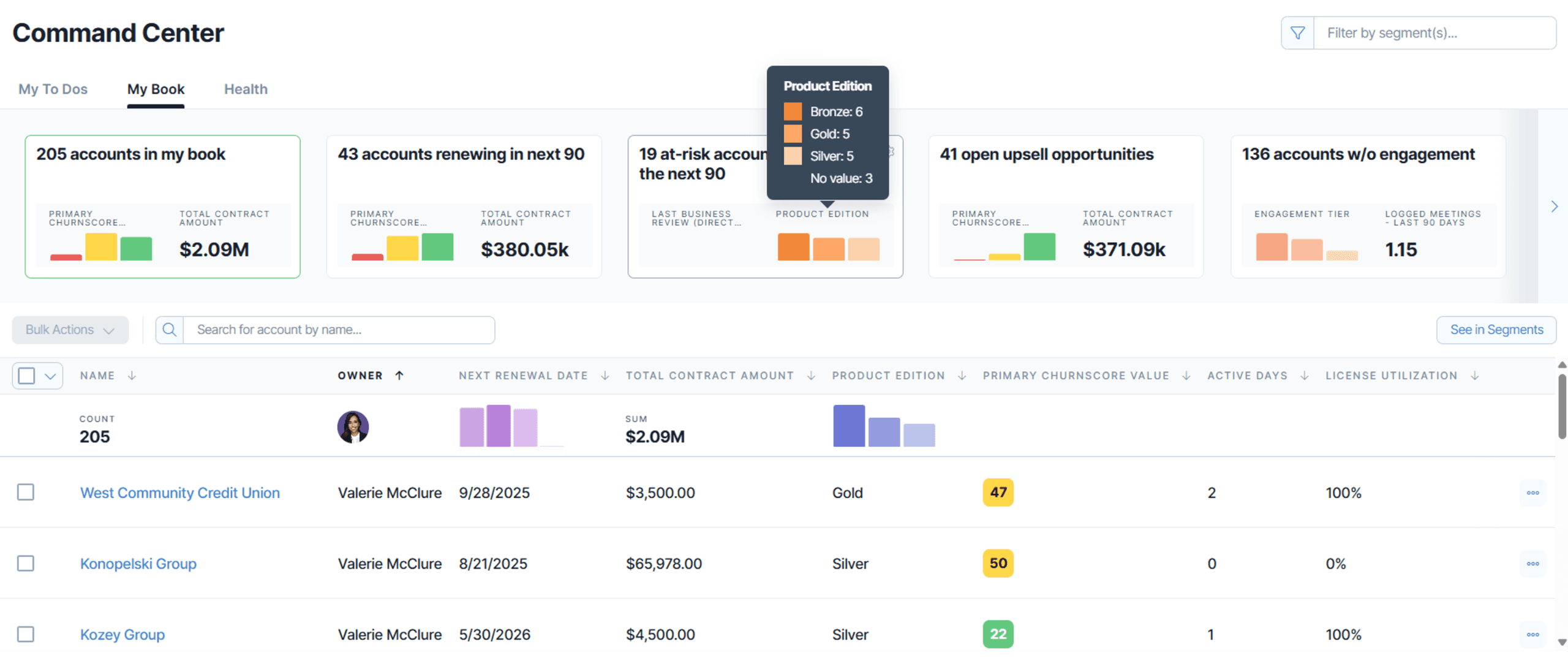
ChurnZero is built specifically for SaaS subscription businesses, and it shows. The platform's core strength is real-time customer health tracking paired with in-app engagement, meaning your team can both see risk and act on it without leaving the tool.
The Churn Score aggregates usage data, support interactions, and engagement signals into a single risk indicator. From there, automated Plays trigger based on customer behavior: onboarding sequences, adoption nudges, renewal prep, risk intervention. In 2025, ChurnZero added AI Agents that go beyond alerting to actively draft outreach and execute playbook steps.
Where ChurnZero shines is the middle of the market. It's lighter than Gainsight but more capable than entry-level tools. The Command Center gives CSMs a centralized view of their portfolio that's genuinely useful day-to-day.
Key capabilities
Pricing
Custom, quote-based. Published benchmarks suggest the Professional tier runs $15,000 to $39,000 annually for 10 users and 500 managed accounts. Enterprise pricing scales with user count and account volume. Costs can escalate quickly as you grow.
Best for
Mid-market SaaS companies (5–20 CSMs) that want deep product usage visibility combined with in-app engagement. Especially strong if you're a SaaS product and want to meet customers inside your app, not just in their inbox.
Honest limitation
The interface has a learning curve. Multiple reviewers describe the onboarding period as overwhelming. And while Plays are powerful, they're closer to automated sequences than true situation-specific playbooks. The "what to do" still often lives in the CSM's head.
Vitally has earned its momentum. It combines a clean, modern interface with genuine depth: health scoring, automated playbooks, project management for customer milestones, collaborative docs, and an AI Copilot that generates summaries and drafts replies from unstructured data like transcripts, notes, and tickets.
What sets Vitally apart from the incumbents is time-to-value. Where Gainsight measures implementation in months, Vitally measures it in weeks. Where ChurnZero requires meaningful configuration before CSMs see benefit, Vitally tends to click faster for the end user.
The platform works across tech-touch, hybrid, and high-touch models without forcing you to choose upfront. That flexibility matters a lot for teams in a growth phase where the CS model is still being defined.
Key capabilities
Pricing
Custom, quote-based across three tiers: Tech-Touch, Hybrid-Touch, and High-Touch. Free trials available. Vitally is generally positioned as more accessible than Gainsight or ChurnZero, though specific pricing isn't published.
Best for
B2B SaaS companies in a growth phase (3–15 CSMs) that want a modern, flexible CS platform without a multi-month implementation project.
Honest limitation
Smaller integration ecosystem compared to Gainsight. Some users on Capterra note that viewer seat limits feel restrictive, and the breadth of features takes time to fully extract value from.
Totango takes a different architectural approach. Instead of giving you a monolithic platform and asking you to configure it, Totango offers SuccessBLOCs - pre-built, customizable workflow modules for specific CS motions like onboarding, adoption tracking, renewal management, and churn prevention. You snap together the pieces you need and add more as you grow.
This composable model is genuinely useful for teams that know they need more than spreadsheets but aren't ready to buy into a full-stack platform. The free Community edition (up to 100 accounts) lets you test the approach before committing budget.
Totango merged with Catalyst in recent years, which expanded the feature set and data integration layer. The Spark integration framework connects well to common data sources.
Key capabilities
Pricing
Free Community plan available. Paid tiers (Starter, Growth, Enterprise) are quote-based, with Growth estimates starting around $2,500/month.
Best for
Teams that want to start small and scale modularly. Also a strong fit for organizations that have tried and failed to implement a larger platform and want a more incremental approach.
Honest limitation
The modular approach can feel like a patchwork once you're running five or six SuccessBLOCs simultaneously. Reporting and analytics are less robust than Gainsight. The Totango + Catalyst integration is still being refined. Expect some rough edges.
Churn Buster solves a different problem than everything else on this list, and it's a problem most CS teams underestimate: involuntary churn from failed payments. Expired cards, insufficient funds, gateway errors, fraud blocks. For subscription businesses, this can quietly account for 20-40% of total churn.
Your billing platform has default retry logic for this. Churn Buster's argument - backed by over a decade of data across 1,000+ subscription businesses - is that default logic leaves significant revenue on the table. Different decline types need different retry timing and different customer communication. An insufficient funds decline is not the same as an expired card, and treating them the same costs you money.
Median recovery rates across their customer base sit around 50%, with top B2B SaaS performers hitting 80–90%. At those numbers, the ROI math is hard to argue with.
Key capabilities
Pricing
Based on recovered revenue. Churn Buster reports typical ROI of 10x+. Contact them for specifics.
Best for
Any subscription business (SaaS or ecommerce) losing meaningful revenue to failed payments. Especially valuable if you've never optimized your dunning process beyond whatever Stripe or your billing platform ships by default.
Honest limitation
Payment recovery only. No health scoring, no CS workflows, no voluntary churn management. You'll use this alongside another tool on this list, not instead of one.
If your CS team is one to five people and you're currently managing churn risk in spreadsheets, CRM notes, or your head, Custify is a solid first step into purpose-built tooling. It offers health scoring, lifecycle automation, renewal tracking, and basic playbook functionality at a price point that won't require a board-level conversation.
Custify's strength is simplicity. The learning curve is gentle, time-to-value is measured in days, and you can be operational before your trial expires. It's not going to blow you away with AI or advanced analytics, but it will get your team off spreadsheets and into a system that actually tracks customer health.
Key capabilities
Pricing
Starts around $999/month for the Starter plan. Growth and Enterprise tiers are quote-based. Free trial available.
Best for
Early-stage SaaS companies with small CS teams that need a purpose-built platform without enterprise complexity. The "first real CS tool" for most teams in this stage.
Honest limitation
You'll likely outgrow it. Analytics and reporting are basic compared to mid-market options. Automation is limited. Once your team passes 10–15 people, you'll probably be shopping for something with more depth.
Knowing if any of these tools are right for you comes down to where your current process breaks.
If the problem is visibility, meaning you don't know who's at risk until it's too late, start with a health-scoring platform. Gainsight for enterprise, ChurnZero or Vitally for mid-market, Custify or Totango if you're early.
If the problem is response, meaning you see the risk but your team's follow-through is inconsistent, improvised, or invisible to leadership, that's Cuelock's lane.
If the problem is payment failures, and you've never touched your default dunning logic, Churn Buster will almost certainly pay for itself.
Most mature CS teams end up with two or three tools from this list. A common stack: a health-scoring platform for visibility, Cuelock for structured risk response, and Churn Buster for payment recovery. That covers identification, action, and involuntary churn in one motion.
Reducing churn is hard. No single tool solves it. But the teams that treat churn response as a system, not a scramble, are the ones that move the needle quarter over quarter. The right stack just makes that system possible.
Written by
Chinmay Pingale · Co-founder & CEO
Chinmay is the co-founder and CEO of Cuelock. He writes about customer success operations, retention, and the mechanics of expansion revenue.

AI agents built around your customer success team, your customers, and your playbook.
 ChatGPT
 Claude