How to Implement Customer Success for Non-SaaS Companies

Chinmay Pingale
Co-founder & CEO

Chinmay Pingale
Co-founder & CEO
I'll be blunt. Customer Success for Non-SaaS companies is not about relationship building. It's about operational reliability under pressure.
Look, most traditional businesses already "have relationships." That's not the bottleneck. The bottleneck is what happens when something goes wrong. Orders slip. Projects stall. Renewals get wobbly. Information lives in emails, Slack, and one person's head. In those moments, your organization behaves like a system without error handling.
Customer success, done well, is the layer that adds that error handling. It's the discipline that turns messy, person-dependent heroics into a repeatable production process. Well instrumented. Well rehearsed. Well documented.
Why this matters? Because retention in non-SaaS compounds slowly and punishes mistakes quickly. Every prevented churn event is not just saved revenue, it's saved distraction, saved cost-to-serve, and saved organizational whiplash.
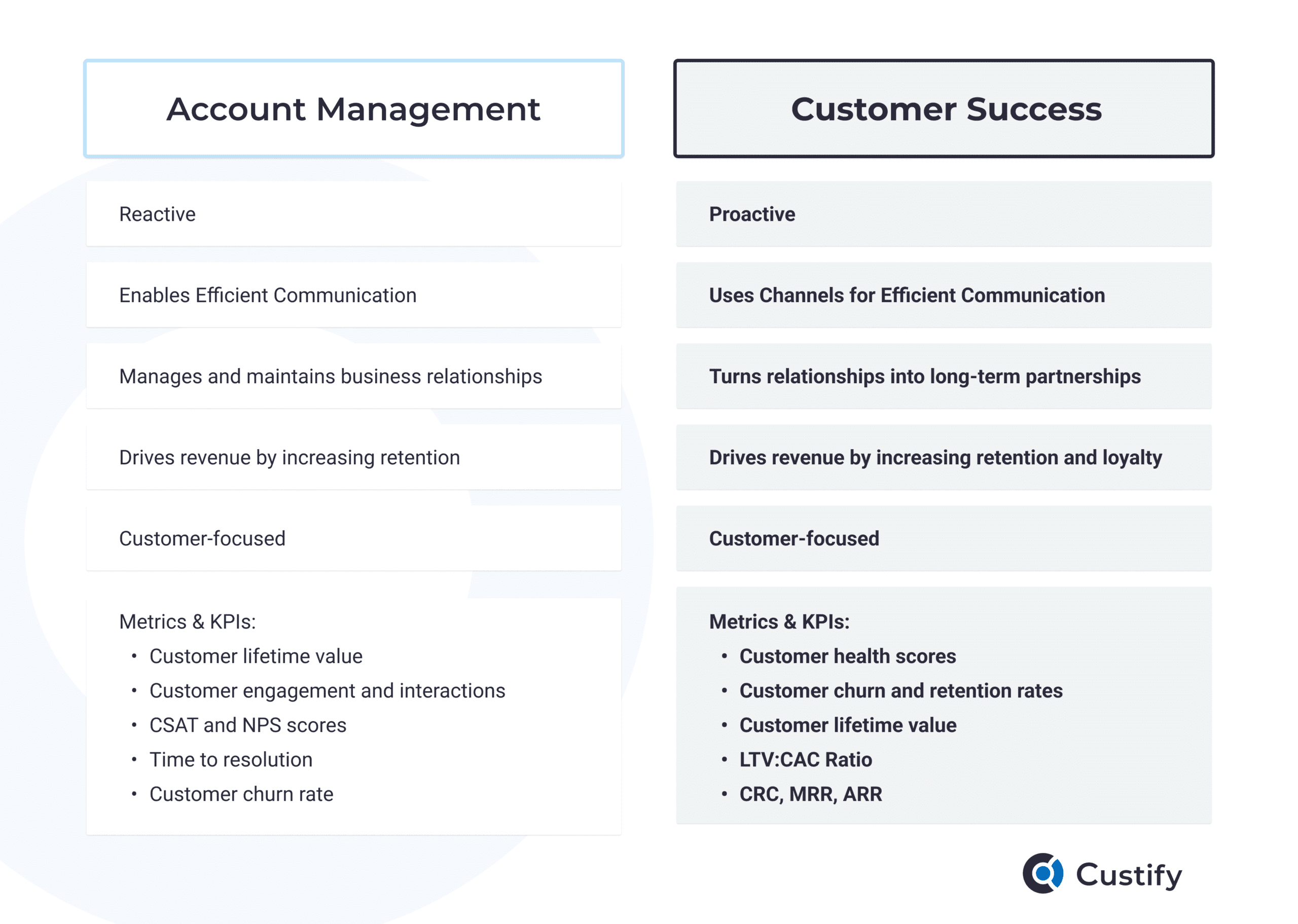
Account management optimizes for relationship and revenue capture. Customer Success optimizes for outcomes and risk reduction.
For account management, the unit of work is the account. For CS, the unit of work is the situation. A risky implementation. A delayed shipment. A troubled renewal.
In my experience at companies like ServiceChannel, the best teams had both. Account managers owned the commercial relationship. CS owned the health of the delivery system. When that line blurred, things got sloppy fast.
Complexity has outrun memory.
More products. More integrations. More stakeholders. More bespoke work. You can't run a modern non-SaaS business on institutional knowledge and hallway handoffs. Customer Success is how you encode that tribal knowledge into a repeatable system that actually works under pressure.
I've seen mid-market industrial suppliers move from "Bob is the system" to structured playbooks that cut renewal escalations by about 50% inside a year. Same revenue. Far less chaos.
Examples include, but are not limited to:
In other words, Customer Success isn't about being nicer to customers, it's about managing operational risk that Sales can't and Delivery won't. If your revenue depends on what happens after the contract is signed, you need a dedicated layer that owns that reality, documents it, and improves it over time. If it doesn't, adding CS just creates another team in the loop without changing any outcomes.
Renaming Account Managers as "CSMs" tends to look like progress on a slide while changing very little in practice. Incentives stay the same, workflows stay the same, and when the next high-stakes moment hits, you still rely on heroics. It's the organizational equivalent of shipping code straight to production without tests you absorb all the risk and get none of the reliability.
The other traps are quieter but just as costly. Teams build elaborate health scores that look impressive in dashboards and get ignored in real life, adding maintenance work without reducing risk. Leaders treat Customer Success purely as a cost center, which optimizes for activity instead of outcomes. And when Sales or Delivery create systemic problems, those issues get routed to individual CSMs, slowly burning them out rather than fixing the underlying system. Cosmetic changes feel safe. They don't move the needle. Real progress starts when you change how the system actually works.
Ask yourself a few simple questions. Do you regularly hit high-stakes moments where retention is on the line? When those moments arrive, does the response depend on who happens to be on shift? And after the fire is out, do you actually extract lessons, or just move on and hope it doesn't happen again?
If the answer to any of these is yes, you're not ahead of the curve. You're already behind it.
Success is not "happy customers." It's durable retention, predictable renewals, and fewer fire drills. Write this down in one sentence. If you can't, you're not ready to build anything.
Sales, Delivery, and Finance need the same definition of success. If Sales sells unrealistic timelines, CS inherits impossible risks.
At a facilities management company I worked with, simply aligning on a single "successful go-live" definition reduced post-sale escalations by roughly 30% over two quarters. Clarity compounds.
What you get: a north star that makes every later decision easier.
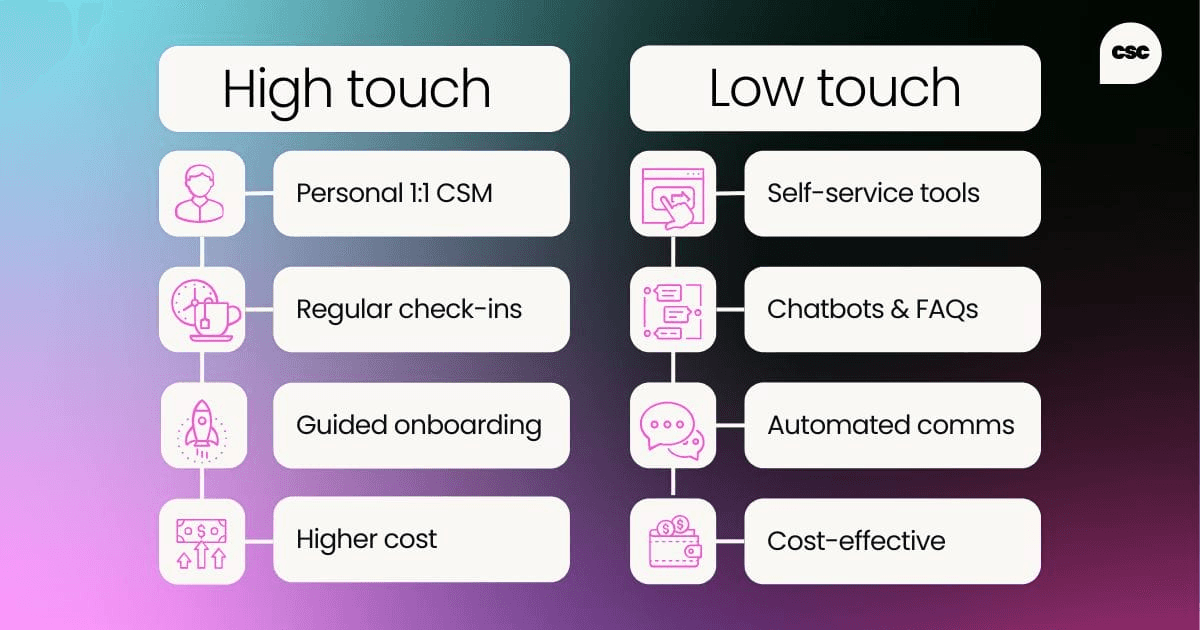
High touch vs. scaled vs. hybrid
For high-touch: deeper relationships, fewer accounts, higher cost, stronger risk mitigation.
For scaled: lighter coverage, more automation, lower cost, more variance in outcomes. Scaled coverage leans heavily on self-serve education. Short customer onboarding videos answer the questions a CSM would otherwise field one call at a time.
The primary difference is control versus efficiency. Most non-SaaS companies land in hybrid. High-touch for strategic accounts, scaled for the long tail.
Who owns onboarding
Here's the thing. If onboarding is messy, CS will spend its life cleaning it up.
My default: Delivery owns execution. CS owns clarity of milestones and risk escalation paths. In the case that you don't have a dedicated Delivery team, it does make sense for CS to own it, but it's crucial to have the correct playbooks in place.
Relationship between sales, implementation, and CS
Sales sells. If you have a delivery or implementation team, they build and execute. Customer Success keeps the train on the tracks after launch. If you don't have a separate delivery team, then Sales closes and hands the relationship to CS, and CS effectively owns post-sale execution and risk. In both cases, the principle is the same: clear lanes reduce friction, and ambiguity creates it.
When those lanes are fuzzy, handoffs turn into blame games and every escalation becomes a debate about "who dropped it." When they're crisp, risk gets owned in the right place and problems get solved faster. What you get is fewer turf wars, smoother transitions, and more forward motion.
Start by making your milestones undeniable. Create one single source of truth that everyone points to, not three spreadsheets and a shared drive no one checks.
Next, assign real owners to every milestone. Name a person, not a team, and make it explicit who moves the ball forward when things slip.
Finally, define what "off track" actually means before you're in the middle of a crisis. Is it a missed date? A budget overrun? A stakeholder going quiet? Spell it out.
Simple. Boring. Effective.
Don't overcomplicate this. A good quarterly review fits on three slides outcomes, risks, and next steps. Outcomes keep you honest about value delivered, risks force you to surface what everyone can see but avoids saying, and next steps create forward motion instead of vague agreement. If you can't run that meeting crisply, no amount of tooling will save you.
I've seen teams at companies like Schneider Electric standardize this simple format and cut "surprise" renewals by more than half within a year. The template didn't win deals by itself. The discipline did.
So the account gets flagged as "at risk," and now you're in production, not planning.
You're moving through your day, and then a critical customer misses a milestone. The Slack pings start. Calendars explode. Pressure spikes. What happens next?
In the good version, there's a clear playbook. You know who leads, what context gets pulled in, and where every action is tracked. In the bad version, everyone reacts in parallel email threads, context fragments, and the loudest voice wins.
Structure beats heroics.
Don't design your renewal process in the final 30 days before a contract comes due. That's when pressure is highest and judgment is worst. The work has to be done while things are calm, not when they're on fire.
Be explicit about the mechanics. Who drafts the renewal? Who is responsible for surfacing risks early? Who owns escalation if something goes sideways? Write it down and make it repeatable instead of relying on memory or goodwill.
When you do this well, you replace end-of-quarter chaos with steady, predictable motion.
A good first Customer Success hire is less a people person in a title and more a systems person who happens to be good with people. They naturally see broken flows before anyone else, own risk instead of deflecting it, and understand how customer outcomes connect to revenue rather than optimizing only for "happiness." They're steady in high-stakes moments, credible with Sales and Delivery from day one, and disciplined about documenting and standardizing what actually works. In practice, you're better off with a system builder who can grow their relational muscle than a pure relationship manager who can't build anything that lasts.
Every business calibrates this differently, and that's fine. A complex services firm will need a different profile than a distributor or a manufacturer, so there isn't one universal "right" archetype. Frankly, your very first CS hire probably won't be perfect, and that's normal. In early-stage functions you learn by doing, which means you'll likely iterate on people as much as on process. Cycling through a hire or two while you figure out what you actually need is not a failure of strategy, it's part of building a function that can scale.
Account Managers are naturally oriented toward the commercial side of the house - how to protect and grow revenue, manage the contract, and navigate pricing and negotiations. Customer Success, by contrast, is oriented toward the health of the account and the mechanics of risk resolution whether milestones are being hit, issues are being surfaced early, and problems are being resolved in a durable way. Both roles create real value, just in different parts of the customer lifecycle. Unless your team is very small or your model is unusually simple, collapsing them into a single role tends to blur incentives and weaken both motions rather than making things cleaner.
When you scale a CS team, the order matters. Start centralized so you can see patterns, agree on what "good" looks like, and standardize how work actually gets done. Only then should you decentralize and embed CS more deeply with different segments, regions, or product lines.
If you push autonomy too early, you don't scale expertise, you scale inconsistency. Done in the right sequence, you end up with a team that compounds its learning instead of fragmenting into isolated silos.
Use health scores lightly. They're best treated as signals, not oracles. A score can nudge you to look closer, but it shouldn't replace judgment or context. When teams start treating a number as ground truth, they stop listening to what's actually happening with the customer.
The key isn't perfect accuracy. It's creating a shared language about risk that Sales, Delivery, and CS can all recognize. A simple, imperfect score that gets everyone aligned and talking about the same problems will outperform a "precise" model that no one trusts or uses.
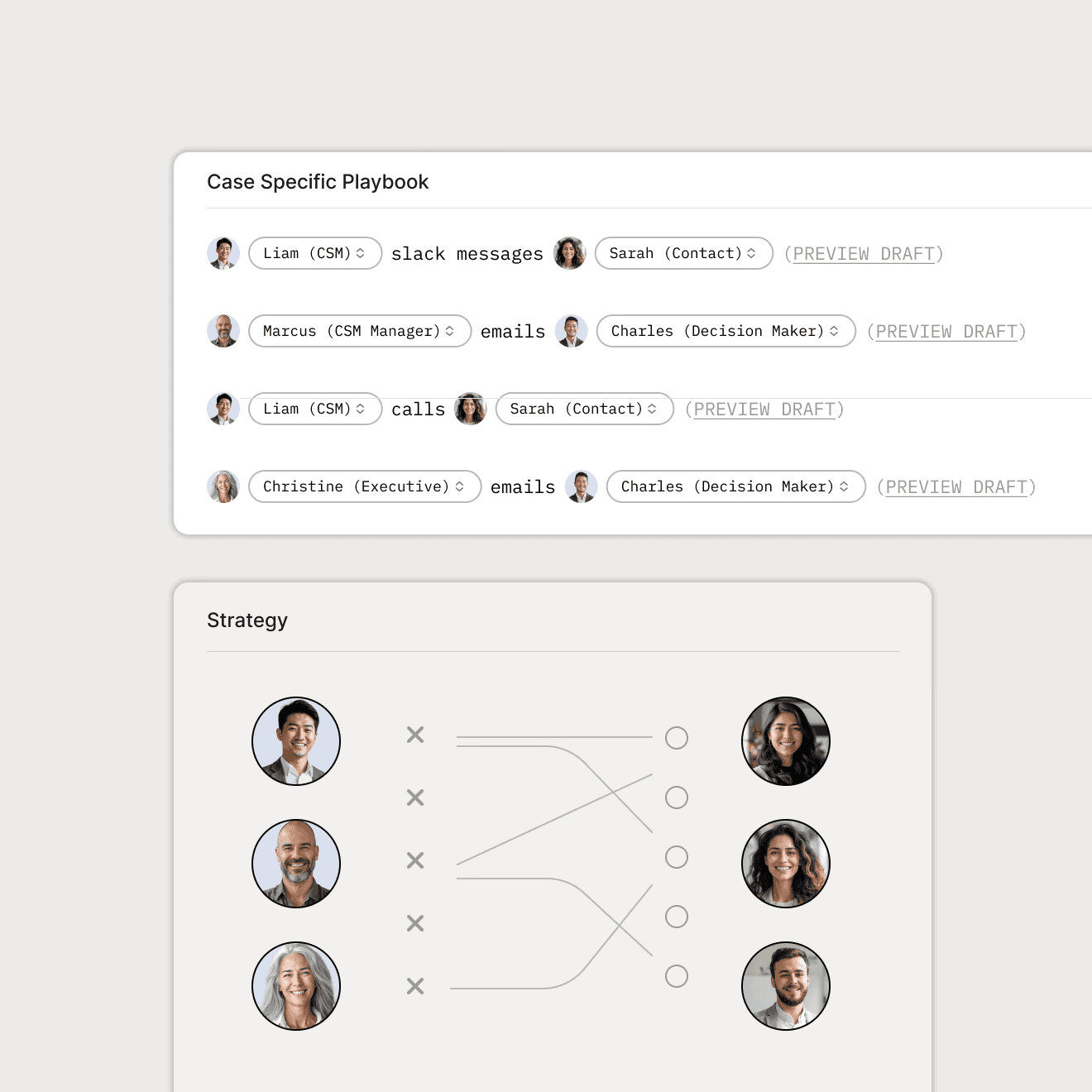
Your CRM should remain the system of record for accounts, contracts, and activity. But when customer risk surfaces, speed without alignment is just chaos in motion, and a CRM is a poor place to run that moment. You need a dedicated space where the team can move fast, stay aligned, and execute a clear, repeatable response so CSMs can focus on the right actions, pull in the right people, and prevent issues from slipping through the cracks. This is exactly the gap Cuelock is built to fill, especially for non-SaaS companies that need more structure and systems around onboarding, renewal, and risk. It gives teams a structured workspace for running playbooks, coordinating stakeholders, and capturing what actually happened so the organization can learn from it and steadily raise its standard for managing customer risk.
This is not meant to be prescriptive, but instead a blueprint that worked for me, and the companies I've helped. The best thing you could do is take inspiration and apply it meaningfully to your organization.
Define success in one sentence. Be explicit about the outcome you care about most. For example: "Reduce last-minute renewal escalations for our top 20 accounts." Write it down and socialize it with Sales, Delivery, and Finance. If people don't nod to the same definition, you're not aligned.
Map your riskiest customer moments. List the 5 to 7 moments that reliably create pain. Examples include, but are not limited to: delayed go-lives, missed milestones, scope creep, executive escalations, or renewal surprises. For each one, note who is involved, what usually breaks, and where information lives today.
Pick one risk scenario to standardize. Choose the moment that is both frequent and high stakes. Don't pick the hardest or the fanciest pick the one that will move the needle in 90 days. This is your beachhead.
What you get: a focused problem that everyone agrees matters.
Ship a lightweight playbook for that scenario. Define three things only:
Keep it short enough that someone could follow it under pressure.
Train the team by running it, not explaining it. Walk through a recent real example together. Ask: "If this happened again tomorrow, what would we do differently?" Calibrate the playbook based on that discussion.
Start documenting every instance in one place. Create a single home for risk cases. Every time the scenario happens, open a record, follow the playbook, and capture what actually occurred. This is where your institutional memory begins.
What you get: a working process you can observe and improve, not a slide deck.
Measure what actually changes, not what looks good on a dashboard. Start with two simple questions. Did escalations for this scenario meaningfully drop? And did renewals or outcomes feel less frantic and less last-minute? If you can't answer those clearly, your playbook still has too much wiggle room and your tooling probably isn't giving you a clean view of what really happened.
Then iterate from reality, not consensus. Tighten ownership where things stalled, simplify steps that people quietly bypassed, and strip out anything that created friction without reducing risk. This is where having a single, structured place like Cuelock to run and review your risk cases pays off you can see patterns instead of relying on memory or scattered Slack threads. Your goal is fewer surprises, not a prettier process.
Finally, decide whether to expand with discipline. If the first scenario is running cleanly, pick a second high-impact risk moment and repeat the cycle. If it isn't, stop. Fix what you have before you scale it.
Written by
Chinmay Pingale · Co-founder & CEO
Chinmay is the co-founder and CEO of Cuelock. He writes about customer success operations, retention, and the mechanics of expansion revenue.

AI agents built around your customer success team, your customers, and your playbook.
 ChatGPT
 Claude